From Hedge Rows to Wild Thickets: A Short History of Tangled Boundaries
Hedge rows and wild thickets reflect changing land uses; learn why boundaries were planted, why they grew untended and how to read their history.
A hedge row and a wild thicket can occupy the same boundary at different points in its working life. Their history is not simply a shift from order to neglect: planted lines have marked land, contained livestock and supplied materials, while unmanaged growth has sometimes been a useful consequence, sometimes a problem, and often both at once.
To read a tangled boundary, look beyond its present shape. Banks, ditches, gaps, cut stems and changes in alignment can suggest how people once used the land, though no single feature tells the whole story.
Why were boundaries planted in the first place?
Before a continuous hedge became a familiar feature of a landscape, boundaries could be marked by stones, banks, ditches, fences or scattered trees. A hedge offered a living barrier that could be laid, cut and replenished. It made a claim visible without requiring a wall of stone along every field edge.
In working countryside, enclosure served practical purposes. A boundary could keep grazing animals out of crops, divide one holding from another, or direct movement along a route. The exact arrangement depended on local custom, land ownership and the work expected of the ground; there was no single universal design.
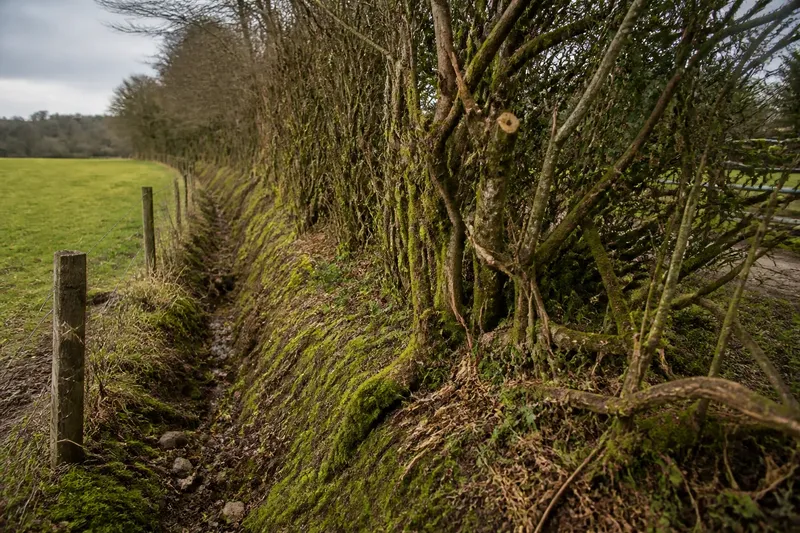
Where a hedge was planted or strengthened on an existing bank, the line could acquire several jobs at once. The bank marked the boundary, the ditch helped drain or define it, and the woody growth made passage harder. Over time, repair and trimming became part of maintaining the line, not an optional improvement to its appearance.
What does a boundary's shape reveal about its use?
Lines that run with field edges may record divisions made for farming, while a boundary that follows a stream, slope or older route may have been shaped by the ground as much as by property. A straight run can reflect a deliberate division; a curving one may follow terrain, an earlier feature or the edge of land that was awkward to cultivate.
Look for changes rather than trying to decode a single clue. A raised bank beside a ditch, a broad base of old woody stems, or a sudden kink may be consistent with a long-maintained boundary, but each can also have another explanation. The useful question is not “What does this prove?” but “What other feature would fit the same history?”
Imagine walking beside a field edge where a low bank continues beneath a dense, uneven line of growth, then stops near a farm track. The bank may mark an older division, while the break may have been kept open for access; a nearby change in field shape could support that reading, but it would not settle it by itself.
On a walk, note the line, nearby land use and any interruptions before assigning a story to it.
How did planted hedges become tangled thickets?
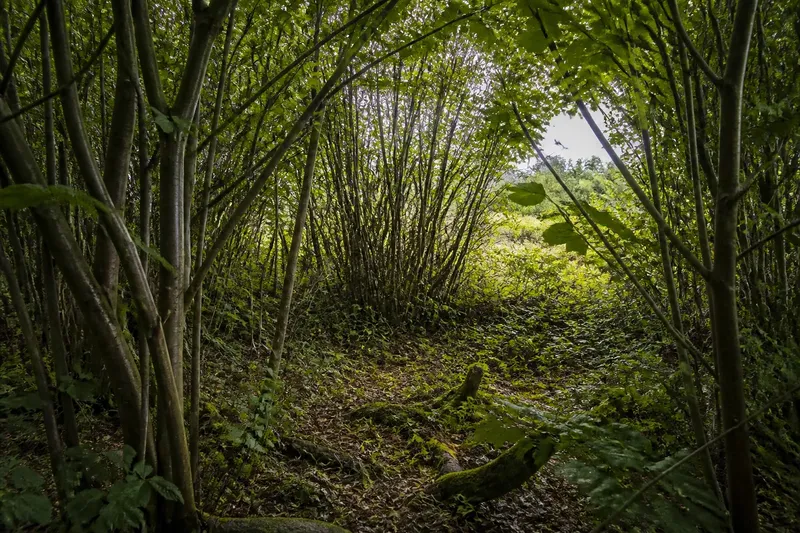
A hedge changes when its maintenance changes. Regular cutting can keep growth compact and define a narrow line; laying or coppicing can renew the barrier while leaving a visible structure. If cutting becomes infrequent, stems rise, branches spread and gaps may fill with new growth. The result can look less like a deliberately managed hedge and more like a thicket, even where the boundary itself remains in use.
Changes in farming and land management have also altered what boundaries are asked to do. A line that once contained livestock may no longer need the same form of close trimming. If the adjacent field is used differently, or the boundary is no longer central to daily work, routine care can become less frequent. Woody growth then expands into the space available to it.
That process is not always a simple matter of abandonment. Some sections may still be cut, while others are left to grow; access points may be maintained even as the rest thickens. A boundary can therefore show several kinds of management at once, each tied to a different task or landowner’s decision.
Why do people mistake a change in use for neglect?
A tall, irregular edge can appear unmanaged because it lacks the crisp profile of a trimmed hedge. Yet height alone does not explain what is happening. The growth may be left deliberately, may be maintained on a longer cycle, or may have spread after its original purpose faded. Conversely, a neat line can still be failing as a barrier if its base has become open.
Confusion often starts when appearance is treated as a record of intention. A boundary that looks wild may still guide livestock, shelter a field edge or mark ownership. Another may be physically present but no longer serve a clear role. To distinguish these possibilities, notice where the line is continuous, where it has been cut and whether nearby access or land use seems to depend on it.
There is also a tendency to read every woody tangle as an old hedge. Some thickets developed along boundaries; others grew on abandoned ground, rough margins or places where cultivation was difficult. A bank or ditch can help connect the growth to a former boundary, but without such context it is safer to describe the feature than to name its origin.
What should you do when a boundary's history is unclear?
Keep the evidence separate from the interpretation. That small discipline prevents a plausible story from turning into a confident one merely because the stems are doing a convincing impression of ancient paperwork.
- Trace the line. Check whether the growth follows a field edge, track, stream or change in slope. If it does, record that relationship before deciding what the boundary was for.
- Look for earthworks. A bank or ditch may support the idea of an established division. If neither is visible, leave room for a fence line, a newer boundary or natural growth.
- Notice management marks. Cut faces, laid stems and abrupt height changes can indicate different treatment. If the marks occur in sections, consider whether upkeep has varied along the line.
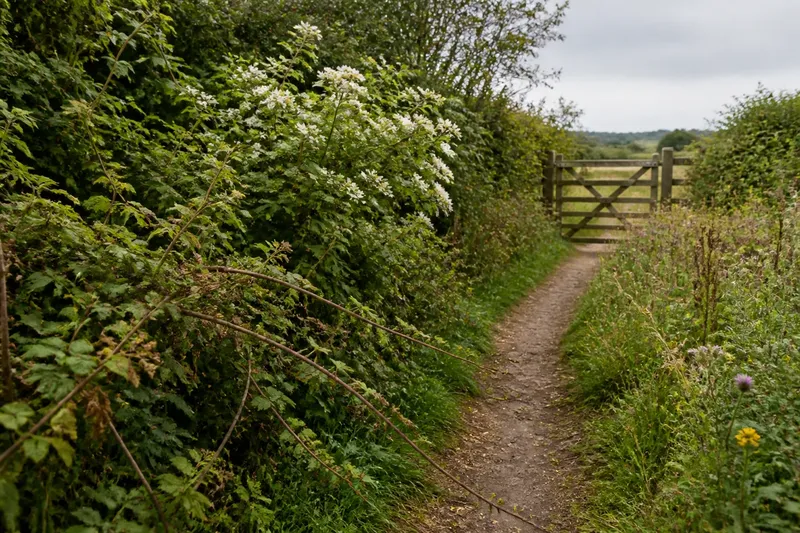
- Check for access points. Gates, openings and worn routes may show where movement was intended. If the line is broken, distinguish a working entrance from a gap that has simply widened.
- Compare the adjoining land. A boundary between unlike uses may have served a different purpose from one within a single field. If the land use has changed, treat the present arrangement as only part of the explanation.
- Write down alternatives. If a feature could be a bank, spoil from ditching or natural rise, list the possibilities. Keep the interpretation provisional until other clues agree.
These checks are for observation, not permission to alter a boundary. Where management decisions affect ownership, access or protected features, local rules and the relevant land manager matter.
How do changing uses alter the boundary's role?
A boundary can shift from a working enclosure to a marker, shelter or rough margin without moving an inch. As fields are reorganised, routes change or grazing patterns alter, a hedge may lose one job and acquire another. The line can remain prominent in the landscape because its physical structure outlasts the purpose that first shaped it.
Less-managed growth may also occupy land that is difficult to work or no longer needed for regular production. In that setting, a thicket is not necessarily the successor to a hedge in any tidy sequence; it may be a nearby patch of growth with a different origin. The distinction matters if you are trying to understand how the landscape was used rather than merely describing what it looks like now.
For a field note, use plain terms first: “raised bank,” “woody boundary,” “open access gap,” or “dense growth along a ditch.” Add an interpretation only when the surrounding features support it. That gives another walker something to check, rather than a finished tale they must either accept or undo.
What questions help distinguish an old hedge from later growth?
Does a raised bank mean the hedge is ancient?
Not by itself. Banks can form or change for several reasons, so look for a consistent boundary line, a ditch or evidence of repeated management before treating it as an old hedge.
Can a wild thicket still mark a property boundary?
Yes. A line may remain a recognised division after regular cutting has stopped, and dense growth can still make its course visible. Its present appearance does not establish who owns or maintains it.
Why might one stretch be neat and the next tangled?
Different sections may have different access needs, owners or management histories. A maintained entrance beside a less frequently cut run can reflect separate tasks rather than one continuous change in practice.
How can I avoid assigning the wrong history?
Describe visible features before interpreting them, then compare the line with nearby banks, ditches, routes and land uses. If those clues do not point in the same direction, keep more than one explanation open.
What is the most useful way to read a tangled boundary?
Read it as a record of changing work, not as a frozen plan. A planted hedge may have enclosed, divided or guided movement; later growth may reflect altered needs, uneven upkeep or ground left outside regular cultivation. The present tangle is the latest layer, not necessarily the whole account.
When you next follow a hedge row into a wilder edge, note where its form changes and what else changes with it: the field, the route, the bank or the pattern of access. That is a more reliable way to understand hedge rows and wild thickets than deciding, from appearance alone, that one is orderly and the other has been forgotten.