Track or Feeding Mark: Which Clue Should You Read First?
Track or feeding mark: compare footprints and browse signs in a thicket, record what each reveals, and avoid turning ambiguous clues into a species guess.
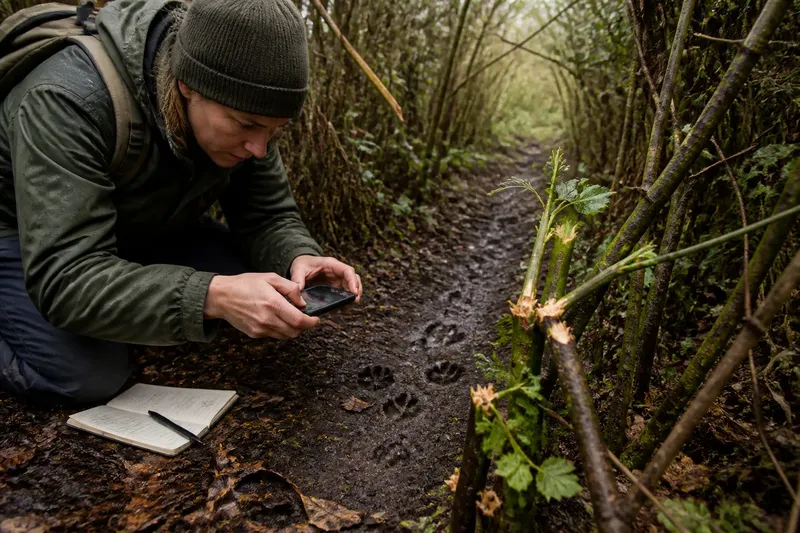
Read a track first when its sequence is clear; read a feeding mark first when the ground is muddled. In a thicket, the useful clue is the one that best answers your question, not necessarily the one that looks most dramatic. Footprints can suggest a route, while chewed stems can indicate feeding, but neither is a species label written in mud or bark.
What can a footprint tell you?
A footprint records contact with the ground at a particular place. Its outline, toe arrangement, visible claws and spacing from other prints may suggest how an animal moved and what broad group it belongs to. A sequence is usually more informative than one impression, which may be distorted by a stone, root or slipping foot.
Start by noting the ground. Damp soil may hold a crisp outline; leaf litter can hide its edges, and soft mud can make a small print appear broad. Rain, wind and passing animals alter marks too. A shallow hollow beside a track could be an impression or simply a patch where water has settled.
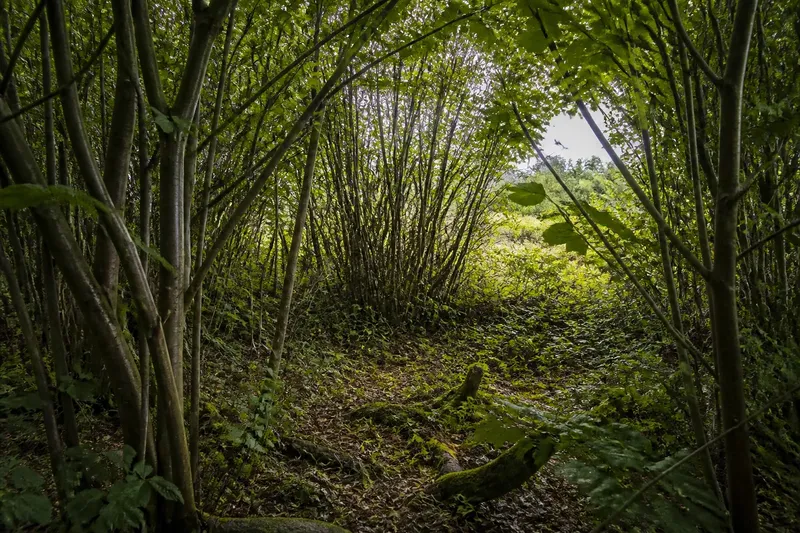
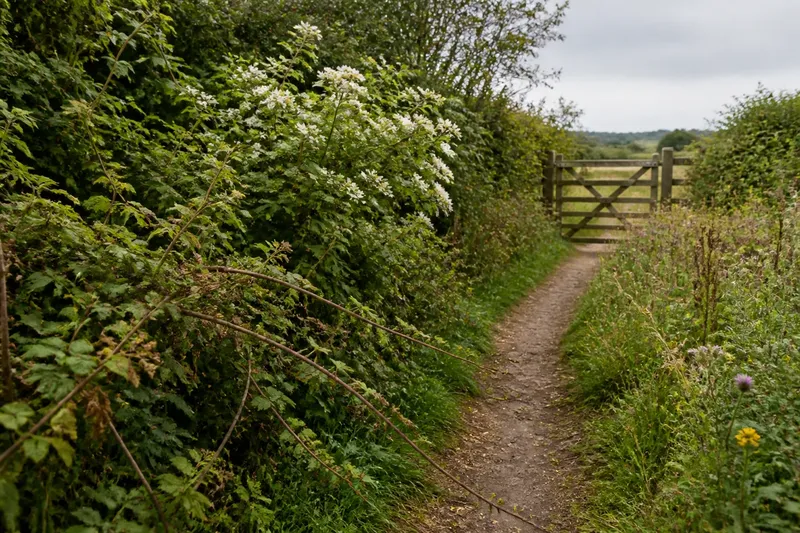
Look for a pattern without forcing one. Several prints in a line may suggest steady travel; irregular spacing can reflect obstacles or changes of pace. In a dense hedge, stems can funnel movement through a narrow opening, showing where an animal passed without revealing what it did there.
Photograph the print from above with a familiar object nearby for scale, and keep your fingers and equipment out of it. In a field notebook, record the ground type, direction and surrounding vegetation. Context makes a photograph useful; a dramatic image on its own is mostly just dramatic.
What does a feeding mark add?
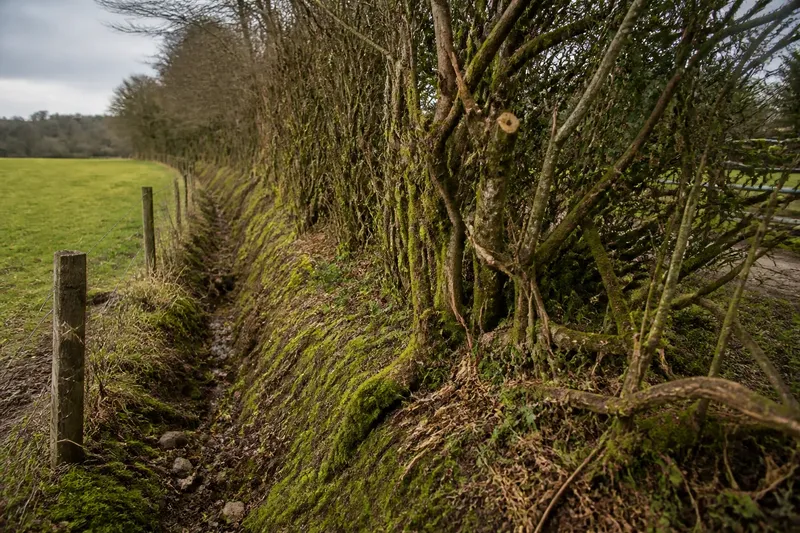
Feeding signs record an action rather than a passage. Look for clipped or torn stems, stripped bark, nibbled buds, disturbed seed heads, nutshells or other food remains. The height and position of the damage may help distinguish browsing from gnawing or breakage, though growth, weather and other animals complicate the picture.
The shape of a cut is worth noting, but rarely settles the question by itself. A clean-looking cut could come from incisors, a sharp break or a tool; ragged edges can result from a plant snapping as well as from feeding. Compare several marks on the same and nearby plants, and consider whether their condition fits the surrounding weather and growth.
Feeding signs may remain where tracks have vanished beneath leaves or softened in rain. They can also indicate what an animal was doing, rather than merely where it went. That distinction is useful in a thicket, where stems hide animals and make routes difficult to follow.
Say you find a freshly nibbled shoot beside a narrow hedge gap, but the ground is dry and covered with leaves. Record the plant, the shape of the damage and the gap’s position; then check the area on a later visit for clearer prints or further browsing. The observable result would be a better-supported note about repeated activity, not an instant species identification.
Which clue should you read first?
Choose the clue that is clearest and most relevant to your question. If you want to know which way an animal travelled, a sequence of prints may be the better starting point. If you want to know what it fed on or whether a plant is being browsed, inspect the damage.
- Several prints in soft ground: If their outlines and direction are clear, follow the sequence in your notes; if they are partial or muddled, record the uncertainty and look for another clue.
- Fresh damage on a plant: If similar marks recur on stems or buds, note the affected parts as possible feeding; if damage is isolated or irregular, consider breakage or another cause.
- Recent rain, trampling or leaf fall: If conditions could have altered a track, do not infer direction from it; if a sheltered print remains clear, describe it while noting the exposure.
- A track and feeding mark close together: If each clue is independently clear, record both separately; if either is ambiguous, avoid linking them to the same animal.
- Repeated visits to the same spot: If fresh signs appear in the same area, note what has changed; if no new signs appear, keep the earlier observation without treating it as ongoing activity.
- Uncertain species identity: If the visible evidence supports only a broad group or action, use that description; if a consequential decision depends on a precise identity, seek advice from a suitably qualified professional.
For a casual walk, the clearest clue may be enough for a careful note. For a repeated survey, describe signs consistently: record ground conditions, print sequence or the plant part affected. Write what is visible before adding an interpretation.
How do track and feeding-mark clues compare?
Can one footprint identify an animal?
Usually it can suggest only a broad possibility, because size and shape change with substrate, angle and how the foot landed. Look for a sequence and note the toes, claws and surrounding conditions before proposing an identity.
Can a chewed stem name its eater?
Not reliably on its own. The plant species, damaged part and cut or tear may narrow the possibilities, but different animals can leave similar marks, and breakage can resemble feeding.
What if the clues seem to disagree?
Keep both observations rather than choosing whichever fits a preferred answer. They may belong to different animals, or one may have been altered; a later visit might provide fresh evidence that clarifies the sequence.
Should I touch or collect the evidence?
Observation is usually enough: photograph the mark, note its setting and leave the ground or plant undisturbed. Follow site instructions and any local access rules.
When can each clue mislead you?
A track can mislead when the ground has softened, dried or been disturbed. What looks like distinct toes may be a partial impression, while an apparent turn may simply vanish under grass. Follow only what remains visible, and mark uncertainty in your notes.
Feeding signs can persist after an animal has moved on, and plant damage may have more than one cause. A broken twig in a windy gap is not automatically browse; bark scraped by a passing branch is not necessarily feeding. Look for repeated, similar marks and consider whether the plant’s position or surrounding growth could explain the damage without an animal.
Dense growth makes both clues harder to read. Low branches obscure the ground, leaves conceal damaged stems, and hedge gaps may collect signs from animals using different routes. Proximity alone does not prove that a footprint and a feeding mark came from the same individual.
How can you make a cautious identification?
Build your account from separate observations. Describe the track’s shape and sequence, then the feeding mark’s location and condition. Add relevant habitat details, such as leaf litter, exposed soil, thorny stems or a nearby opening, without treating the setting as an identification in its own right.
Compare your notes with reliable local field guides or advice from a knowledgeable naturalist. If identification matters for management, conservation or another consequential decision, consult a suitably qualified professional rather than relying on a single sign. For ordinary nature watching, “small mammal track” or “fresh browsing” is often more honest and useful than a confident guess.
For track or feeding mark, begin with the clue you can describe most clearly, then let the other test rather than decorate your interpretation. A careful note about what an animal may have done is often more useful than a name the evidence cannot yet support.