Why Dense Stems Make a Thicket Feel Like a Room
Learn how layered stems and leaves make a thicket feel like a room, shaping shelter, sightlines and the distinct boundary between dense growth and open ground.
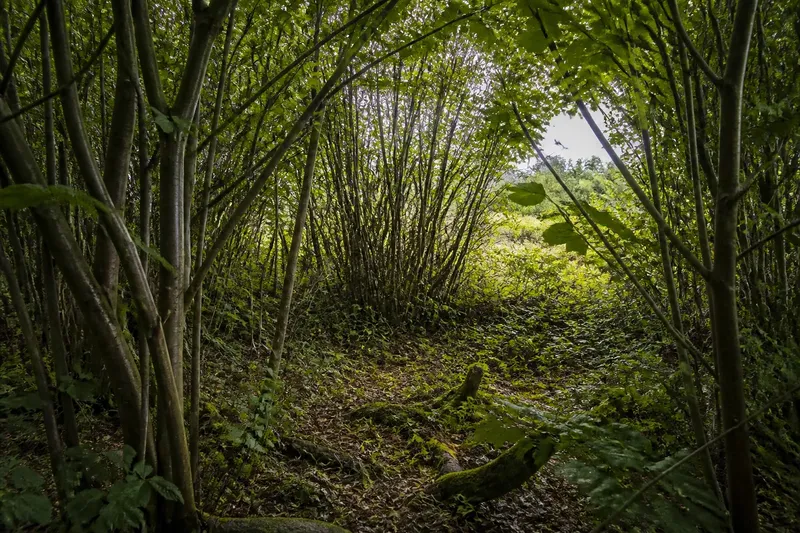
A thicket feels like a room because its stems and leaves organise space: they narrow sightlines, soften the wind and create sheltered pockets within a larger landscape. Dense stems do more than block a view. Their height, spacing and layers give a walker a sense of an inside, an edge and an outside, even without a roof or a straight wall.
How does a thicket become a room?
Start with the simplest comparison. In open ground, the eye can travel across a broad area, and wind generally has fewer obstacles at the same height. Inside dense growth, branches interrupt both. The result is not complete enclosure but a sequence of partial screens that make each nearby space feel more distinct.
The effect depends on several structures working together. Upright trunks or canes form a visible framework; side branches fill some gaps; leaves or needles soften the remaining openings. Low growth may hide the ground ahead, while taller growth lets light enter above shoulder level. A thicket can therefore feel enclosed at one height and open at another.
There is no single wall. From one position, a gap between stems may frame a view; a few steps sideways can close it again. That shifting boundary is part of the room-like sensation: the space responds to where you stand.
What do stem spacing and layers change?
Spacing controls whether stems read as separate objects or as a screen. Widely spaced trunks leave long views through the stand. Closely set stems overlap from a walker’s viewpoint, so the background becomes harder to distinguish. The stems need not touch; visual overlap can make them seem to form a continuous partition.
Layers matter just as much. A thicket with a high canopy but an open lower level may feel airy beneath it, while a dense shrub layer can make the same canopy seem like a ceiling over a smaller chamber. Brambles, young saplings and low boughs complicate that lower space further, marking routes that are visible but not comfortably passable.
Look at the growth at several heights rather than judging density from the canopy alone. A quick scan from knee level to above your head often explains why a stand feels open in one direction and closed in another.
Why does visibility affect the sense of shelter?
People read space partly through what they can see beyond it. In an open field, a distant tree line or slope gives the eye a clear destination. Among overlapping stems, the view ends nearby, so attention settles on the next opening, trunk or patch of light. The thicket feels smaller than the land it occupies because its visible boundaries are close.
Those boundaries are not necessarily fixed. A person looking through a gap may see a bright strip of field, while someone a short distance to the side sees only leaves. The first view suggests a passage; the second makes the vegetation seem solid. This is why a thicket’s apparent shape changes with viewpoint more readily than the outline of a building.
Light helps distinguish one pocket from another. Sunlight filtering through upper leaves can brighten an interior patch while leaving nearby stems in shade. The contrast gives the eye a foreground, a middle distance and a partial background, much as separate walls and openings do indoors.
How do thickets interrupt wind and sound?
Stems and foliage break up moving air, though the effect varies with the stand’s density, height and position. A sheltered pocket may feel calmer than exposed ground nearby, while a narrow gap can channel a breeze. Thickets are not sealed rooms; air still passes through, and gusts may find their way along the edge or through a thinner patch.
Leaves and fine branches also scatter sound. A nearby bird call, rustle or footstep can seem close while distant sounds become less distinct behind the vegetation. The thicket does not make a dependable sound barrier, but it changes which noises reach you clearly. That altered soundscape can reinforce the impression of separation from open ground.
Notice where a breeze reaches your face and where leaves move. Those small differences can reveal gaps in the screen that are difficult to spot from a single angle.
What questions help explain a thicket’s room-like feel?
Can a thicket feel enclosed without a dense canopy?
Yes. A thick middle or lower layer can screen the sides even when the upper growth leaves the sky visible. The sense of enclosure comes from the parts that define your immediate view, not from a complete cover overhead.
Why can the same thicket feel open from one side?
Growth is rarely uniform, and an edge may have fewer stems or a broader gap than the interior. From that approach, the eye can look into the stand before the foliage blocks the view, making the boundary feel less firm.
Does dense growth always make a safer shelter?
No general conclusion follows from appearance alone. Dense stems can reduce exposure to wind in some pockets, but they can also hide uneven ground, fallen branches or an obstructed route; treat the space as natural terrain, not a built shelter.
How can I tell where the thicket’s edge really is?
Look for a gradual change in stem spacing, light and the length of visible gaps rather than expecting a clean line. The perceived edge may shift as you move, especially where shrubs and young trees spread beyond taller trunks.
How does the room change as you move?
A thicket is experienced from a moving viewpoint, not as a plan viewed from above. On a path, stems pass close to the body and briefly hide what lies ahead. A turn can reveal a pocket that was concealed moments before, or make a promising opening disappear behind a branch.
Imagine approaching a patch of hazel with a bright opening visible between two trunks. As you walk a few paces to the left, a low branch lines up with one trunk and closes the view; moving back to the path restores it. The observable change is in the sightline, not in the plants, and it shows why the apparent room has a shifting boundary.
To read that space, pause at a path edge and compare three views: straight ahead, slightly to either side, and down towards the ground. Note which stems overlap, where light enters and whether a gap continues beyond the first layer. This is observation, not an invitation to push through uncertain cover.
What does the room-like structure mean for the landscape?
Dense growth divides a broad patch of land into smaller visible spaces. A person may experience separate pockets even where stems connect them, while animals can use the same structure for concealment or movement. The vegetation’s layered form shapes those possibilities without making every pocket identical.
Edges are particularly revealing. At the boundary with grassland or a path, stems may thin gradually, so the transition feels like a doorway rather than a wall. In another place, a dense fringe can hide the interior until a narrow gap opens. Neither form is a literal room; both describe how vegetation controls what can be seen from outside.
The practical point is simple: when describing a thicket, say what the stems do to the view. “A close screen with a bright gap above” tells a reader more than “very dense”, and it captures why the place feels separate from the open ground beside it.
That is the useful distinction behind the room-like feel of a thicket: its boundaries are made by layered stems, shifting sightlines and pockets of shelter, not by a single enclosing wall. Watch how the view changes as you move, and the thicket’s inner spaces become easier to read without assuming they are closed or uniform.